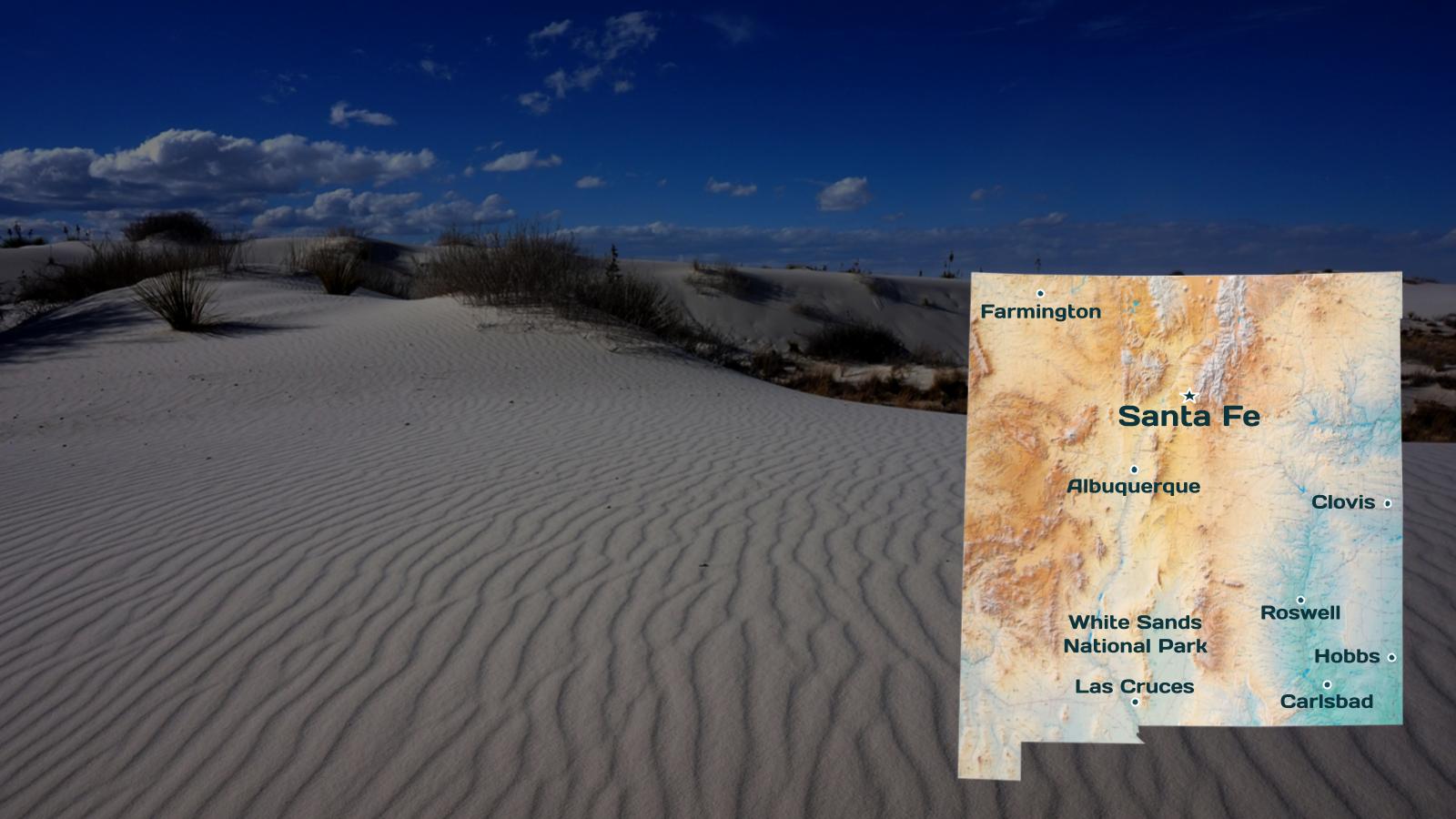
Summary
New Mexico is a state in the Southwestern United States; its capital is Santa Fe, which was founded in 1610 as capital of Nuevo México (itself established as a province of New Spain in 1598), while its largest city is Albuquerque with its accompanying metropolitan area. It is one of the Mountain States of the Southern Rocky Mountains, and shares the Four Corners region of the Western U.S. with Utah, Colorado, and Arizona. New Mexico is also bordered by the state of Texas to the east-southeast, Oklahoma to the northeast, and the Mexican states of Chihuahua to the south and Sonora to the southwest.
With a population of 2,120,220 as of the 2020 U.S. Census, New Mexico is the 36th largest state by population. With a total area of 121,590 sq mi (314,900 km2), it is the fifth-largest and sixth-least densely populated of the 50 states. Due to their geographic locations, northern and eastern New Mexico exhibit a colder alpine climate, while western and southern New Mexico exhibit a warmer arid climate; the Rio Grande and its fertile valley runs from north-to-south creating a riperian climate in the middle of the state, supplying central New Mexico with its bosque (gallery forest) and distinct Albuquerque Basin climate.
OnAir Post: About New Mexico
About
Source: Wikipedia page

.svg)


.jpg)


.jpg)
.jpg)


Demographics
Population
Population</span>”}]]}’>Pop.

The 2020 census recorded a population of 2,117,522, an increase of 2.8% from 2,059,179 in the 2010 census.[115] This was the lowest rate of growth in the western U.S. after Wyoming, and among the slowest nationwide.[116] By comparison, between 2000 and 2010, New Mexico’s population had increased by 11.7% from 1,819,046—a faster rate than the national average.[117] A report commissioned in 2021 by the New Mexico Legislature attributed the state’s slow growth to a negative net migration rate, particularly among those 18 or younger, and to a 19% decline in the birth rate.[116] However, growth among Hispanics and Native Americans remained healthy.[116][Note 4]
The U.S. Census Bureau estimated a slight decrease in population, with 3,333 fewer people from July 2021 to July 2022.[118] This was attributed to deaths exceeding births by roughly 5,000, with net migration mitigating the loss by 1,389.[118]
More than half of New Mexicans (51.4%) were born in the state; 37.9% were born in another state; 1.1% were born in either Puerto Rico, an island territory, or abroad to at least one American parent; and 9.4% were foreign born (compared to a national average of roughly 12%).[119] Almost a quarter of the population (22.7%) was under the age of 18, and the state’s median age of 38.4 is slightly above the national average of 38.2. New Mexico’s somewhat older population is partly reflective of its popularity among retirees: It ranked as the most popular retirement destination in 2018,[120] with an estimated 42% of new residents being retired.[121]
Hispanics and Latinos constitute nearly half of all residents (49.3%), giving New Mexico the highest proportion of Hispanic ancestry among the fifty states. This broad classification includes descendants of Spanish colonists who settled between the 16th and 18th centuries, as well as recent immigrants from Latin America (particularly Mexico and Central America).
From 2000 to 2010, the number of persons in poverty increased to 400,779, or approximately one-fifth of the population.[117] The 2020 census recorded a slightly reduced poverty rate of 18.2%, albeit the third highest among U.S. states, compared to a national average of 10.5%. Poverty disproportionately affects minorities, with about one-third of African Americans and Native Americans living in poverty, compared with less than a fifth of whites and roughly a tenth of Asians; likewise, New Mexico ranks 49th among states for education equality by race and 32nd for its racial gap in income.[122]
New Mexico’s population is among the most difficult to count, according to the Center for Urban Research at the City University of New York, due to the state’s size, sparse population, and numerous isolated communities.[116] Likewise, the Census Bureau estimated that roughly 43% of the state’s population (about 900,000 people) live in such “hard-to-count” areas.[116] In response, the New Mexico government invested heavily in public outreach to increase census participation, resulting in a final tally that exceeded earlier estimates and outperformed several neighboring states.[123]
According to HUD‘s 2022 Annual Homeless Assessment Report, there were an estimated 2,560 homeless people in New Mexico.[124][125]
Race and ethnicity

.jpg)

New Mexico is one of seven “majority-minority” states where non-Hispanic whites constitute less than half the population.[126] As early as 1940, roughly half the population was estimated to be nonwhite.[127] Before becoming a state in 1912, New Mexico was among the few U.S. territories that were predominantly nonwhite, which contributed to its delayed admission into the Union.[128]
The largest ethnic group is Hispanic and Latino Americans; according to the 2020 census they account for nearly half the state’s population, at 47.7%; they include Hispanos descended from pre-United States settlers and more recent successions of Mexican Americans.[129][130][131]
Some 200,000 residents, about one-tenth of the population, are of Indigenous descent,[132] ranking third in size,[133] and second proportionally,[134] among all states nationwide. There are 23 federally recognized tribal nations, each with its distinct culture, history, and identity. Both the Navajo and Apache share Athabaskan origin, with the latter living on three federal reservations in the state.[135] The Navajo Nation, which spans over 16 million acres (6.5 million ha), mostly in neighboring Arizona, is the largest reservation in the U.S., with one-third of its members living in New Mexico.[132] Pueblo Indians, who share a similar lifestyle but are culturally and linguistically distinct, live in 19 pueblos scattered throughout the state, which collectively span over 2 million acres (800,000 ha).[136] Many indigenous New Mexicans have moved to urban areas throughout the state, and some cities such as Gallup are major hubs of Native American culture.[137] New Mexico is also a hub for indigenous communities beyond its borders: the annual Gathering of Nations, which began in 1983, has been described as the largest pow wow in the U.S., drawing hundreds of native tribes from across North America.[138]
Almost half of New Mexicans claim Hispanic origin; many are descendants of colonial settlers called Hispanos or Nuevomexicanos, who settled mostly in the north of the state between the 16th and 18th centuries; by contrast, the majority of Mexican immigrants reside in the south. Some Hispanos claim Jewish ancestry through descendance from conversos or Crypto-Jews among early Spanish colonists.[139] Many New Mexicans speak a unique dialect known as New Mexican Spanish, which was shaped by the region’s historical isolation and various cultural influences; New Mexican Spanish lacks certain vocabulary from other Spanish dialects and uses numerous Native American words for local features, as well as anglicized words that express American concepts and modern inventions.[140]
New Mexico has the fourth largest Native American community in the U.S., at over 200,000; comprising roughly one-tenth of all residents, this is the second largest population by percentage after Alaska.[141][142] New Mexico is also the only state besides Alaska where indigenous people have maintained a stable proportion of the population for over a century: In 1890, Native Americans made up 9.4% of New Mexico’s population, almost the same percentage as in 2020.[143] By contrast, during that same period, neighboring Arizona went from one-third indigenous to less than 5%.[143]
New Mexico’s population consists of many mestizo Indo-Hispano groups, including Hispanos of Oasisamerican descent and Indigenous Mexican American with Mesoamerican ancestry.[144][145]

Non-Hispanic White
40–50%50–60%60–70%70–80%Native American
40–50%80–90%Hispanic or Latino
40–50%50–60%60–70%70–80%
In the 2020 Census, 45,904 New Mexico residents were identified as African American (2.2% of the total).[146] African Americans in the five counties of Bernalillo (21,344), Doña Ana (4,072), Sandoval (3,327), Curry (2,900), and Lea (2,801) make up more than 75% of all African Americans in the state.[147]
| Racial composition | 1970[148] | 1990[148] | 2000[149] | 2010[150] | 2020[151] |
|---|---|---|---|---|---|
| Hispanic or Latino | 37.4% | 38.2% | 42.1% | 46.3% | 47.7% |
| White (non-Hispanic) | 53.8% | 50.4% | 44.7% | 40.5% | 36.5% |
| Native | 7.2% | 8.9% | 9.5% | 9.4% | 10.0% |
| Black | 1.9% | 2.0% | 1.9% | 2.1% | 2.1% |
| Asian | 0.2% | 0.9% | 1.1% | 1.4% | 1.8% |
| Native Hawaiian and other Pacific Islander | – | – | 0.1% | 0.1% | 0.1% |
| Other | 0.6% | 12.6% | 17.0% | 15.0% | 15.0% |
| Two or more races | – | – | 3.6% | 3.7% | 19.9% |
| Race / Ethnicity (NH = Non-Hispanic) | Pop 2000[152] | Pop 2010[153] | [154] | % 2000 | % 2010 | % 2020 |
|---|---|---|---|---|---|---|
| White alone (NH) | 813,495 | 833,810 | 772,952 | 44.72% | 40.49% | 36.50% |
| Black or African American alone (NH) | 30,654 | 35,462 | 38,330 | 1.69% | 1.72% | 1.81% |
| Native American or Alaska Native alone (NH) | 161,460 | 175,368 | 188,610 | 8.88% | 8.52% | 8.91% |
| Asian alone (NH) | 18,257 | 26,305 | 35,261 | 1.00% | 1.28% | 1.67% |
| Pacific Islander alone (NH) | 992 | 1,246 | 1,451 | 0.05% | 0.06% | 0.07% |
| Other race alone (NH) | 3,009 | 3,750 | 10,340 | 0.17% | 0.18% | 0.49% |
| Mixed race or Multiracial (NH) | 25,793 | 29,835 | 59,767 | 1.42% | 1.45% | 2.82% |
| Hispanic or Latino (any race) | 765,386 | 953,403 | 1,010,811 | 42.08% | 46.30% | 47.74% |
| Total | 1,819,046 | 2,059,179 | 2,117,522 | 100.00% | 100.00% | 100.00% |
According to the 2022 American Community Survey,[155][156][157] the most commonly claimed ancestry groups in New Mexico were:
- Mexican (32.8%)
- Other Hispanic (Hispano/Spanish) (15.3%)
- English (8.0%)
- German (7.9%)
- Irish (6.4%)
- Diné (6.3%)
- Pueblo (2.4%)
According to 2020 census data, 19.9% of the population identifies as multiracial/mixed-race, a population larger than the Native American, Black, Asian and NHPI population groups.[151] Almost 90% of the multiracial population in New Mexico identifies as Hispanic or Latino.[158]
- Birth data
The majority of live births in New Mexico are to Hispanic whites, with Hispanics of any race consistently accounting for over half of all live births since 2013.
| Race | 2014[159] | 2015[160] | 2016[161] | 2017[162] | 2018[163] | 2019[164] | 2020[165] | 2021[166] | 2022[167] | 2023[168] | 2024[169] |
|---|---|---|---|---|---|---|---|---|---|---|---|
| White | 7,222 (27.7%) | 7,157 (27.7%) | 7,004 (28.4%) | 6,522 (27.4%) | 6,450 (28.0%) | 6,218 (27.1%) | 5,872 (26.8%) | 5,754 (26.9%) | 5,531 (25.6%) | 5,232 (25.0%) | 5,311 (24.9%) |
| American Indian | 3,581 (13.7%) | 3,452 (13.4%) | 2,827 (11.4%) | 2,694 (11.3%) | 2,603 (11.3%) | 2,643 (11.5%) | 2,434 (11.1%) | 2,152 (10.1%) | 2,221 (10.3%) | 2,063 (9.8%) | 2,097 (9.8%) |
| Asian | 578 (2.2%) | 517 (2.0%) | 425 (1.7%) | 420 (1.8%) | 409 (1.8%) | 392 (1.7%) | 410 (1.8%) | 351 (1.6%) | 412 (1.9%) | 393 (1.9%) | 403 (1.9%) |
| Black | 732 (2.8%) | 664 (2.6%) | 354 (1.4%) | 387 (1.6%) | 387 (1.7%) | 355 (1.5%) | 403 (1.8%) | 372 (1.7%) | 403 (1.9%) | 381 (1.8%) | 362 (1.7%) |
| Hispanic (any race) | 14,449 (55.5%) | 14,431 (55.9%) | 13,639 (55.2%) | 13,362 (56.2%) | 12,783 (55.4%) | 12,924 (56.3%) | 12,406 (56.6%) | 12,354 (57.7%) | 12,617 (58.4%) | 12,461 (59.5%) | 12,640 (59.3%) |
| Total | 26,052 (100%) | 25,816 (100%) | 24,692 (100%) | 23,767 (100%) | 23,039 (100%) | 22,960 (100%) | 21,903 (100%) | 21,391 (100%) | 21,614 (100%) | 20,951 (100%) | 21,328 (100%) |
Immigration
A little over 9% of New Mexican residents are foreign-born, and an additional 6.0% of U.S.-born residents live with at least one immigrant parent.[170] The proportion of foreign-born residents is below the national average of 13.7%, and New Mexico was the only state to see a decline in its immigrant population between 2012 and 2022.[171]
In 2018, the top countries of origin for New Mexico’s immigrants were Mexico, the Philippines, India, Germany and Cuba.[172] As of 2021, the vast majority of immigrants in the state came from Mexico (67.6%), followed by the Philippines (3.1%) and Germany (2.4%).[170]
Notwithstanding their relatively small population, immigrants play a disproportionately large role in New Mexico’s economy, accounting for almost one-eighth (12.5%) of the labor force,15% of entrepreneurs, and 19.1% of personal care aides, as well as 9.1% of workers in STEM fields.[170]
Languages
| English only | 64% |
|---|---|
| Spanish | 28% |
| Navajo | 4% |
| Others | 4% |
New Mexico ranks third after California and Texas in the number of multilingual residents.[173] According to the 2010 U.S. census, 28.5% of the population age 5 and older speak Spanish at home, while 3.5% speak Navajo.[174][175] Most speakers of New Mexican Spanish are descendants of pre-18th century Spanish settlers.[176] Contrary to popular belief, New Mexican Spanish is not an archaic form of 17th-century Castilian Spanish; though some archaic elements exist, linguistic research has determined that the dialect “is neither more Iberian nor more archaic” than other varieties spoken in the Americas.[177][178] Nevertheless, centuries of isolation during the colonial period insulated the New Mexican dialect from “standard” Spanish, leading to the preservation of older vocabulary as well as its own innovations.[179][180]
Besides Navajo, which is also spoken in Arizona, several other Native American languages are spoken by smaller groups in New Mexico, most of which are endemic to the state. Native New Mexican languages include Mescalero Apache, Jicarilla Apache, Tewa, Southern Tiwa, Northern Tiwa, Towa, Keres (Eastern and Western), and Zuni. Mescalero and Jicarilla Apache are closely related Southern Athabaskan languages, and both are also related to Navajo. Tewa, the Tiwa languages, and Towa belong to the Kiowa-Tanoan language family, and thus all descend from a common ancestor. Keres and Zuni are language isolates with no relatives outside of New Mexico.
Official language
New Mexico’s original state constitution of 1911 required all laws be published in both English and Spanish for twenty years after ratification;[181] this requirement was renewed in 1931 and 1943,[182] with some sources stating the state was officially bilingual until 1953.[183] Nonetheless, the current constitution does not declare any language “official”.[184] While Spanish was permitted in the legislature until 1935, all state officials are required to have good knowledge of English; consequently, some analysts argue that New Mexico cannot be considered a bilingual state, since not all laws are published in both languages.[182]
The state legislature remains constitutionally empowered to publish laws in English and Spanish and to appropriate funds for translation. Whenever a referendum to approve an amendment to the New Mexican constitution is held, ballots must be printed in both English and Spanish.[185] Certain legal notices must be published in both English and Spanish, and the state maintains a list of newspapers for Spanish publication.[186]
In the judiciary, witnesses and defendants have the right to testify in either language, and monolingual speakers of Spanish have the same right to serve on juries as English speakers.[184][187] In public education, the state is constitutionally obligated to provide bilingual education and Spanish-speaking instructors in school districts where the majority of students are Hispanophone.[184] The constitution also provides that citizens who speak neither English nor Spanish have a right to vote, hold public office, and serve on juries.[188]
In 1989, New Mexico became the first of only four states to officially adopt the English Plus resolution, which supports acceptance of non-English languages.[189] In 1995, the state adopted an official bilingual song, “New Mexico – Mi Lindo Nuevo México“.[190]: 75, 81 In 2008, New Mexico was the first state to officially adopt a Navajo textbook for use in public schools.[191]
Religion
[192] Like most U.S. states, New Mexico is predominantly Christian. According to Association of Religion Data Archives (ARDA), the largest denominations in 2010 were the Catholic Church (684,941 members); the Southern Baptist Convention (113,452); The Church of Jesus Christ of Latter-day Saints (67,637), and the United Methodist Church (36,424).[193] Approximately one-fifth of residents are unaffiliated with any religion, which includes atheists, agnostics, and deists. A 2020 study by the Public Religion Research Institute (PRRI) determined 67% of the population were Christian, with Roman Catholics constituting the largest denominational group.[194] In 2025, the PRRI estimated 62% of the population were Christian, with Protestants now having become the largest denominational group.[195] Roman Catholicism is deeply rooted in New Mexico’s history and culture, going back to its settlement by the Spanish in the early 17th century. The oldest Christian church in the continental U.S., and the third oldest in any U.S. state or territory, is the San Miguel Mission in Santa Fe, which was built in 1610. Within the hierarchy of the Catholic Church, New Mexico belongs to the ecclesiastical province of Santa Fe. The state has three ecclesiastical districts:[196] the Archdiocese of Santa Fe, the Diocese of Gallup, and the Diocese of Las Cruces.[197] Evangelicalism and nondenominational Christianity have seen growth in the state since the late 20th century: The Billy Graham Evangelistic Association has hosted numerous events in New Mexico,[198][199] and Albuquerque has several megachurches, which have numerous satellite locations in the state, including Calvary of Albuquerque, Legacy Church, and Sagebrush Church.[200] New Mexico has been a leading center of the New Age movement since at least the 1960s, attracting adherents from across the country.[197] The state’s “thriving New Age network” encompasses various schools of alternative medicine, Holistic Health, psychic healing, and new religions, as well as festivals, pilgrimage sites, spiritual retreats, and communes.[201][202] New Mexico’s Japanese American community has influenced the state’s religious heritage, with Shinto and Zen represented by Kagyu Shenpen Kunchab, Kōbun Chino Otogawa, Upaya Institute and Zen Center.[203] Likewise, Holism is represented in New Mexico, as are associated faiths such as Buddhism and Seventh-day Adventism;[204][205] a Tibetan Buddhist temple is located at Zuni Mountain Stupa in Grants. Religious education, art, broadcasting, media exist across religions and faiths in New Mexico, including KHAC, KXXQ, Dar al-Islam, and Intermountain Jewish News. Christian schools in New Mexico are encouraged to receive educational accreditation, and among them are the University of the Southwest, St. Pius High School, Hope Christian, Sandia View Academy, St. Michael’s High School, Las Cruces Catholic School, St. Bonaventure Indian School, and Rehoboth Christian School. Albuquerque’s growing media sector has made it a popular hub for several national Christian media institutions, such as Trinity Broadcasting Network‘s KNAT-TV. Christian artistic expression includes the gospel tradition within New Mexico music,[206] and contemporary Christian music such as KLYT radio station.[207] Several indigenous and Christian religious sites are registered and protected as part of regional and global cultural heritage.[208][209] Reflecting centuries of successive migrations and settlements, New Mexico has developed a distinct syncretic folk religion that is centered on Puebloan traditions and Hispano folk Catholicism, with some elements of Diné Bahaneʼ, Apache, Protestant, and Evangelical faiths.[210] This unique religious tradition is sometimes referred to as “Pueblo Christianity” or “Placita Christianity”, referring to both the Pueblos and Hispanic town squares.[211] Customs and practices include the maintenance of acequias,[212] Pueblo and Territorial Style churches,[212] ceremonial dances such as the matachines,[213][214] religious artistic expression of kachinas and santos,[215] religious holidays celebrating saints such as Pueblo Feast Days,[216] Christmas traditions of bizcochitos and farolitos or luminarias,[217][218] and pilgrimages like that of El Santuario de Chimayo.[219] The luminaria tradition is a cultural hallmark of the Pueblos and Hispanos of New Mexico and a part of the state’s distinct heritage. The luminaria custom has spread nationwide, both as a Christmas tradition as well as for other events. New Mexico’s distinctive faith tradition is believed to reflect the religious naturalism of the state’s indigenous and Hispano peoples, who constitute a pseudo ethnoreligious group.[220] New Mexico’s leadership within otherwise disparate traditions such as Christianity, the Native American Church, and New Age movements has been linked to its remote and ancient indigenous spirituality, which emphasized sacred connections to nature, and its over 300 years of syncretized Pueblo and Hispano religious and folk customs.[197][201] The state’s remoteness has likewise been cited as attracting and fostering communities seeking the freedom to practice or cultivate new beliefs.[201] Global spiritual leaders including Billy Graham and Dalai Lama, along with community leaders of Hispanic and Latino Americans and indigenous peoples of the North American Southwest, have remarked on New Mexico being a sacred space.[221][222][223] According to a 2017 survey by the Pew Research Center, New Mexico ranks 18th among the 50 U.S. states in religiosity, 63% of respondents stating they believe in God with certainty, with an additional 20% being fairly certain of the existence of God, while 59% considering religion to be important in their lives and another 20% believe it to be somewhat important.[224] Among its population in 2022, 31% were unaffiliated.[192]
Economy

Oil and gas production, the entertainment industry, high tech scientific research, tourism, and government spending are important drivers of the state economy.[225][226][227][228][229] The state government has an elaborate system of tax credits and technical assistance to promote job growth and business investment, especially in new technologies.[230] In 2025, 99.0% of businesses in the state were small businesses and employed 53.3% of its work force.[231]
In 2025, New Mexico’s gross domestic product was $152.778 billion[232] compared to roughly $80 billion in 2010.[233] State GDP peaked in 2019 at nearly $99 billion but declined in the face of the COVID-19 pandemic. New Mexico’s per capita personal income was $61,645 in 2025[232] compared to $31,474 in 2007;[234] it was the third lowest in the country after West Virginia and Mississippi.[235] The percentage of persons below the poverty level has largely plateaued in the 21st century, from 18.4% in 2005 to 18.2% in 2021.[236][115] As of May 2025, the state’s unemployment rate was 4.2%.[237]
Traditionally dependent on resource extraction, ranching, and railroad transportation, New Mexico has increasingly shifted towards services, high-end manufacturing, and tourism.[238][239] Since 2017, the state has seen a steady rise in the number of annual visitors, peaking in 2021 at 39.2 million tourists, who had an economic impact of $10 billion.[240] New Mexico has also seen greater investment in media and scientific research.
Transportation

New Mexico has long been an important corridor for trade and migration. The builders of the ruins at Chaco Canyon also created a radiating network of roads from the mysterious settlement.[241] Chaco Canyon’s trade function shifted to Casas Grandes in the present-day Mexican state of Chihuahua; however, north–south trade continued. Ancient Indigenous trade with Mesoamerican cultures included northbound exotic birds, seashells, and copper. Turquoise, pottery, and salt were some of the goods transported south along the Rio Grande. Present-day New Mexico’s pre-Columbian trade is especially remarkable for being undertaken on foot. The north–south trade route later became a path for horse-drawn colonists arriving from New Spain as well as trade and communication; later called El Camino Real de Tierra Adentro, it was among the four “royal roads” that were crucial lifelines to Spanish colonial possessions in North America.[242]

The Santa Fe Trail was the 19th-century territory’s vital commercial and military highway link to the Eastern United States.[243] Several trails that terminated in northern New Mexico, including the Camino Real, the Santa Fe Trail and the Old Spanish Trail are recognized as National Historic Trails. New Mexico’s latitude and low passes made it an attractive east–west transportation corridor.[244] As a territory, the Gadsden Purchase increased New Mexico’s land area for the purpose of constructing a southern transcontinental railroad, that of the Southern Pacific Railroad. Another transcontinental railroad was completed by the Atchison, Topeka and Santa Fe Railway. The railroads essentially replaced the earlier trails but prompted a population boom. Early transcontinental auto trails later crossed the state, bringing more migrants. Railroads were later supplemented or replaced by a system of highways and airports. Today, New Mexico’s Interstate Highways approximate the earlier land routes of the Camino Real, the Santa Fe Trail, and the transcontinental railroads.
Road

Personal automobiles remain the primary means of transportation for most New Mexicans, especially in rural areas.[107] The state had 59,927 route miles of highway as of 2000, of which 7,037 receive federal aid.[245] That year there were 1,003 miles (1,614 km) of freeways, of which 1,000 were the route miles of Interstate Highways 10, 25 and 40.[246] The former number has increased with the upgrading of roads near Pojoaque, Santa Fe, and Las Cruces to freeways. Notable bridges include the Rio Grande Gorge Bridge near Taos. Larger cities in New Mexico typically have some form of public transportation by road; ABQ RIDE is the state’s largest such system.[247] Rural and intercity public transportation by road is provided by Americanos USA, LLC, Greyhound Lines, and several government operators.
New Mexico is plagued by poor road conditions, with roughly a third of its roadways suffering from “inadequate state and local funding”.[248] As of 2001, 703 highway bridges, or one percent, were declared “structurally deficient” or “structurally obsolete”.[249] Data from 2019 found 207 bridges and more than 3,822 miles of highway in less than subpar condition, resulting in greater commute times and higher costs in vehicles maintenance.[250]
New Mexico has historically had a problem with drunk driving, though this has lessened: According to the Los Angeles Times, the state once had the nation’s highest alcohol-related crash rates but ranked 25th in this regard by 2009.[251] The highway traffic fatality rate was 1.9 per million miles traveled in 2000, the 13th-highest among U.S. states.[252] A 2022 report cited poor road as a major factor in New Mexico’s continually high traffic fatalities; between 2015 and 2019, close 1,900 people were killed in automotive crashes in the state.[248]
Highways
New Mexico has only three Interstate Highways: Interstate 10 travels southwest from the Arizona state line near Lordsburg to the area between Las Cruces and Anthony, near El Paso, Texas; Interstate 25 is a major north–south interstate highway starting from Las Cruces to the Colorado state line near Raton; and Interstate 40 is a major east–west interstate highway starting from the Arizona state line west of Gallup to the Texas state line east from Tucumcari. In Albuquerque, I-25 and I-40 meet at a stack interchange called The Big I. The state is tied with Delaware, North Dakota, Puerto Rico, and Rhode Island in having the fewest primary interstate routes, which is partly a reflection of its rugged geography and sparse population.[253]
New Mexico currently has 15 United States Highways, which account for over 2,980 miles (4,800 km) of its highway system. All but seven of its 33 counties are served by U.S. routes, with most of the remainder connected by Interstate Highways. Most routes were built in 1926 by the state government and are still managed and maintained by state or local authorities. The longest is U.S. 70, which spans over 448 miles (721 km) across southern New Mexico, making up roughly 15% of the state’s total U.S. Highway length; the shortest is U.S. 160, which runs just 0.86 miles (1.38 km) across the northwestern corner of the state, between the Arizona and Colorado borders.
The most famous route in New Mexico, if not the United States, was U.S. 66, colloquially known as the nation’s “Mother Road” for its scenic beauty and importance to migrants fleeing West from the Dust Bowl of the 1930s.[254] The road crossed through northern New Mexico, connecting the cities of Albuquerque and Gallup, before being replaced by I-40 in 1985. Much of U.S. 66 remains in use for tourism and has been preserved for historical significance.[255] Another famous route was U.S. 666, which ran south to north along the western portion of the state, serving the Four Corners area. It was known as the “Devil’s Highway” due to the number 666 denoting the “Number of the beast” in Christianity; this numerical designation, as well as its high fatality rate, was subject to controversy, superstition, and numerous cultural references. U.S. 666 was subsequently renamed U.S. Route 491 in 2003. Many existing and former highways in New Mexico are recognized for their aesthetic, cultural, or historical significance, particularly for tourism purposes.[256] The state hosts ten out of 184 “America’s Byways”, which are federally designated for preservation due to their scenic beauty or national importance.[257]
Rail

There were 2,354 route miles of railroads in 2000; this number increased by a few miles with the opening of the Rail Runner‘s extension to Santa Fe in 2006.[258] In addition to local railroads and other tourist lines, the state jointly owns and operates a heritage narrow-gauge steam railroad, the Cumbres and Toltec Scenic Railway, with the state of Colorado since 1970. Narrow-gauge railroads once connected many communities in the northern part of the state, from Farmington to Santa Fe.[259]: 110 No fewer than 100 railroads of various names and lineage have operated in the state at some point.[259]: 8 New Mexico’s rail transportation system peaked in length after it became a U.S. state; in 1914, eleven railroads operated 3,124 route miles.[259]: 10
Railroad surveyors arrived in New Mexico in the 1850s shortly after it became a U.S. territory.[260] The first railroads incorporated in 1869,[259]: 9 and the first railway became operational in 1878: the Atchison, Topeka & Santa Fe Railway (ATSF), which entered via the lucrative and contested Raton Pass. The ATSF reached El Paso, Texas in 1881, and with the entry of the Southern Pacific Railroad from the Arizona Territory in 1880, created the nation’s second transcontinental railroad, with a junction at Deming.[259]: 9, 18, 58–59 [260] The Denver & Rio Grande Railway, which generally used narrow gauge equipment in New Mexico, entered the territory from Colorado, beginning service to Española in December 1880.[259]: 95–96 [260] These first railroads were built as long-distance corridors; later railroad construction also targeted resource extraction.[259]: 8–11

The rise of rail transportation was a major source of demographic and economic growth, with many settlements expanding or established shortly thereafter. As early as 1878, the ATSF promoted tourism in the region with an emphasis on Native American imagery.[261]: 64 Named trains often reflected the territory they traveled: Super Chief, the streamlined successor to the Chief;[261] Navajo, an early transcontinental tourist train; and Cavern, a through car operation connecting Clovis and Carlsbad (by the early 1950s as train 23–24), were some of the named passenger trains of the ATSF that connoted New Mexico,[259]: 49–50 [262]: 51 The Super Chief became a favorite of early Hollywood stars and among the most famous named trains in the U.S.; it was known for its luxury and exoticness, with cars bearing the name of regional Native American tribes and outfitted with the artwork of many local artists, but also for its speed, taking as little as 39 hours 45 minutes to reach Los Angeles from Chicago.[261]

At its height, passenger train service connected nine of New Mexico’s present ten most populous cities (the sole exception is Rio Rancho); only Albuquerque and Santa Fe are still connected by rail.[263] With the decline of most intercity rail service in the U.S. in the late 1960s, New Mexico was left with minimal services; no less than six daily long-distance roundtrip trains, supplemented by many branch-line and local trains, served New Mexico in the early 1960s. Declines in passenger revenue, but not necessarily ridership, prompted many railroads to turn over their passenger services in truncated form to Amtrak, a state-owned enterprise. Amtrak, also known as the National Passenger Railroad Corporation, began operating the two extant long-distance routes on May 1, 1971.[259][261][262] Resurrection of passenger rail service from Denver to El Paso, a route once plied in part by the ATSF’s El Pasoan,[262]: 37 has been proposed; in the 1980s, Governor Toney Anaya suggested building a high-speed rail line connecting the two cities with New Mexico’s major cities.[264] In 2004, the Colorado-based nonprofit Front Range Commuter Rail was established, with the goal of connecting Wyoming and New Mexico with high-speed rail;[265] it became inactive in 2011.[266]

Since 2006, a state-owned, privately run commuter railway, the New Mexico Rail Runner Express, has served the Albuquerque metropolitan area, connecting the city proper with Santa Fe and other communities.[263][267] The system expanded in 2008 with the addition of the BNSF Railway‘s line from Belen to a few miles south of Lamy.[268] Phase II of Rail Runner extended the line northward to Santa Fe from the Sandoval County station, the northernmost station under Phase I service; the service now connects Santa Fe, Sandoval, Bernalillo, and Valencia counties. Rail Runner operates scheduled service seven days per week,[269] connecting Albuquerque’s population base and central business district to downtown Santa Fe with up to eight roundtrips in a day; the section of the line running south to Belen is served less frequently.[270]
Amtrak’s Southwest Chief passes through daily at stations in Gallup, Albuquerque, Lamy, Las Vegas, and Raton, offering connections to Los Angeles, Chicago and intermediate points.[271] A successor to the Super Chief and El Capitan,[262]: 115 the Southwest Chief is permitted a maximum speed of 90 mph (140 km/h) in various places on the tracks of the BNSF Railway;[272] it also operates on New Mexico Rail Runner Express trackage. The Sunset Limited makes stops three times a week in both directions at Lordsburg, and Deming, serving Los Angeles, New Orleans and intermediate points.[273] The Sunset Limited is the successor to the Southern Pacific Railroad‘s train of the same name and operates exclusively on Union Pacific trackage in New Mexico.
New Mexico is served by two of the nation’s ten class I railroads, which denote the highest revenue railways for freight: the BNSF Railway and the Union Pacific Railroad. Together, they operate 2,200 route miles of railway in the state.[258]
Aerospace
New Mexico has four primary commercial airports that are served by most major domestic and international airliners. Albuquerque International Sunport is the state’s main aerial port of entry and by far the largest airport: It is the only one designated a medium-sized hub by the Federal Aviation Administration, serving millions of passengers annually.
.jpg)
The only other comparatively large airports are Lea County Regional Airport, Roswell International Air Center, and Santa Fe Regional Airport, which have varying degrees of service by major airlines. Most airports in New Mexico are small, general aviation hubs operated by municipal and county governments, and usually served solely by local and regional commuter airlines.
Due to its sparse population and many isolated, rural communities, New Mexico ranks among the states most reliant on Essential Air Service, a federal program that maintains a minimal level of scheduled air service to communities that are otherwise unprofitable for commercial airlines.
Spaceport America
New Mexico hosts the world’s first operational and purpose-built commercial spaceport, Spaceport America, located in Upham, near Truth or Consequences.[274][275][276] It is operated by the state-backed New Mexico Spaceport Authority (NMSA). Rocket launches began in April 2007,[276] with the spaceport officially opening in 2011.[277] Tenants include HAPSMobile, UP Aerospace, SpinLaunch, and Virgin Galactic.[278]
Over 300 suborbital flights have been successfully launched from Spaceport America since 2006, with the most notable being Virgin Galactic’s VSS Unity on May 22, 2021, which made New Mexico the third U.S. state to launch humans into space, after California and Florida.[279][280]
On October 22, 2021, Spaceport America was the site of the first successfully tested vacuum-sealed “suborbital accelerator”, which aims to offer a significantly more economical alternative to launching satellites via rockets.[281] Conducted by Spaceport tenant SpinLaunch, the test is the first of roughly 30 demonstrations being planned.[281]
Government and politics

The Constitution of New Mexico was adopted by popular referendum in 1911. It establishes a republican form of government based on popular sovereignty and a separation of powers. New Mexico has a bill of rights modeled on its federal counterpart, but with more expansive rights and freedoms; for example, victims of certain serious crimes, such as aggravated battery and sexual assault, have explicit rights to privacy, dignity, and the timely adjudication of their case.[282] Major state issues may be decided by popular vote, and the constitution may be amended by a majority vote of both lawmakers and the electorate.[283]
Governmental structure
Mirroring the federal system, the New Mexico government consists of executive, legislative, and judicial departments. The executive is led by the governor and other popularly elected officials, including the lieutenant governor (elected on the same ticket as the governor), attorney general, secretary of state, state auditor, state treasurer, and commissioner of public lands. New Mexico’s governor is granted more authority than those of other states, with the power to appoint most high-ranking officials in the cabinet and other state agencies.[21]
The legislative branch consists of the bicameral New Mexico Legislature, comprising the 70-member House of Representatives and the 42-member Senate. Members of the House are elected to two-year terms, while those of the Senate are elected every four years. New Mexican legislators are unique in the U.S. for being volunteers, receiving only a daily stipend while in session; this “citizen legislature” dates back to New Mexico’s admission as a state, and is considered a source of civic pride.[284]
The judiciary is headed by the New Mexico Supreme Court, the state’s highest court, which primarily adjudicates appeals from lower courts or government agencies. It is made up of five judges popularly elected every eight years with overlapping terms. Below the state supreme court is the New Mexico Court of Appeals, which has intermediate appellate jurisdiction statewide. New Mexico has 13 judicial districts with circuit courts of general jurisdiction, as well as various municipal, magistrate, and probate courts of limited jurisdiction.
New Mexico is organized into numerous local governments consisting of counties, municipalities, and special districts.[285]
Politics
Since 2018, New Mexico has been led by Governor Michelle Lujan Grisham and Lieutenant Governor Howie Morales, both of the Democratic Party. All constitutional officers are currently Democrats, including Secretary of State Maggie Toulouse Oliver,[286] Attorney General Raúl Torrez,[287] State Auditor Joseph Maestas,[288] State Land Commissioner Stephanie Garcia Richard,[289] and State Treasurer Laura Montaya.[290]
| Party | Number of voters | Fraction | |
|---|---|---|---|
| Democratic | 570,211 | 42.40% | |
| Republican | 454,199 | 32.18% | |
| Independent / other | 331,872 | 23.51% | |
| Libertarian | 15,520 | 1.10% | |
| Total | 1,411,370 | 100.0% | |
Both chambers of the New Mexico Legislature have Democratic majorities: 27 Democrats and 15 Republicans in the Senate, and 45 Democrats and 25 Republicans in the House of Representatives. Likewise, the state is represented in the U.S. Senate by Democrats Martin Heinrich and Ben Ray Luján. The state’s three delegates to the U.S. House of Representatives are Democrats Melanie Stansbury, Gabe Vasquez, and Teresa Leger Fernandez, representing the first, second, and third districts, respectively.

Since achieving statehood in 1912, New Mexico has been carried by the national popular vote winner in every presidential election except in 1976 and 2024.[292] Until 2008, New Mexico was a swing state in presidential elections. The 1992 election of Bill Clinton marked the first time the state was won by a Democrat since Lyndon B. Johnson in 1964. Al Gore narrowly carried the state in 2000, and George W. Bush won in 2004 by less than 6,000 votes. The election of Barack Obama in 2008 marked the state’s transition into a Democratic stronghold; Obama was also the first Democrat to win a majority of New Mexico votes since Johnson.[293] Obama won New Mexico again in 2012, followed by Hillary Clinton in 2016, Joe Biden in 2020, and Kamala Harris in 2024.

Although state politics are decidedly Democratic-leaning, New Mexico’s political culture is relatively moderate and bipartisan by national standards. While registered Democrats outnumber registered Republicans by nearly 200,000, New Mexico voters have historically favored moderate to conservative candidates of both parties at the state and federal levels: according to Pew Research, the largest political ideology among New Mexicans is political moderate at 36%, while 34% are conservatives, 23% are liberal, and 7% stated they did not know.[294] Likewise, New Mexico’s demographics are atypical of most traditional liberal states with “political ideology less important” than candidates’ profiles or outreach efforts.[295] Due to their historically positive connections to the state’s heritage, the Republican and Democratic parties of New Mexico are each relatively robust, and New Mexico is considered a bellwether state.[296][297][298][299][300] The state’s Republican Party was the first to incorporate Hispanics and Natives into leadership roles, such as territorial governor Miguel Antonio Otero and state governor Octaviano Ambrosio Larrazolo, later the first Mexican American and first Hispanic member of the U.S. Senate.[301][302] Republican president Theodore Roosevelt greatly respected the Hispanos, Mexican Americans, and indigenous communities of New Mexico, many of whom had been part of his Rough Riders.[303][304]
Lujan Grisham succeeded two-term Republican governor Susana Martinez on January 1, 2019. Gary Johnson was governor from 1995 to 2003 as a Republican, but in 2012 and 2016 ran for president as the Libertarian Party nominee. New Mexico’s Second Congressional District is among the most competitive in the country: Republican Herrell narrowly lost to Democrat Xochitl Torres Small in 2018, retook her seat in 2020, and lost to Democrat Gabe Vasquez in 2022.[295] Election cycles within the past decade have seen moderate incumbents replaced by progressive Democrats in cities like Albuquerque, Santa Fe, and Las Cruces, with conservative Republicans elected in rural areas. Democrats are usually strongest in the Santa Fe area, parts of the Albuquerque metro area (such as the southeast and central areas, including the affluent Nob Hill neighborhood and the vicinity of the University of New Mexico), Northern and West Central New Mexico, and Native American reservations, especially the Navajo Nation.[293] Republicans have traditionally had strongholds in the state’s east and south, the Farmington area, Rio Rancho, and the newly developed areas in the northwest mesa. Albuquerque’s Northeast Heights have historically leaned Republican but have recently become a key swing area for Democrats.
A 2020 study ranked New Mexico as the 20th-hardest state for citizens to vote in, primarily due to the inaccessibility of polling stations for many isolated communities.[305]
Female minority representation
New Mexico has elected more women of color to public office than any other U.S. state.[306] While the trend is partly reflective of the state’s disproportionately high Hispanic and indigenous populations, it also reflects longstanding cultural and political trends: In 1922, Soledad Chávez Chacón was the first woman elected secretary of state of New Mexico, and the first Hispanic woman elected to statewide office in the United States. Republican governor Susana Martinez was the first Hispanic female governor in the United States, and Democrat congresswoman Deb Haaland was among the first Native American women elected to the U.S. Congress.[307][308]
Research by the Center for American Women and Politics at Rutgers University found that two-thirds of all nonwhite women who have ever been elected governor in the U.S. are from New Mexico, including the current governor, Lujan Grisham. The state also accounts for nearly one-third of the women of color who have served in any statewide executive office, such as lieutenant governor and secretary of state, a distinction shared by only ten other states.[306] New Mexico also has a relatively high percentage of state legislators who are women of color, which at 16% is the sixth highest in the nation.
New Mexico is described as a “national leader in electing female legislators”.[309] As of January 2023, it ranked sixth in the number of female state legislators (43.8%),[310] with women comprising a majority of the New Mexico House of Representatives (53%) and over a quarter of the Senate (29%).[309] Women also hold a majority of seats on the state Supreme Court and the Court of Appeals.[309] At the federal level, two out of three congressional districts are represented by women.
Local government
Local government in New Mexico consists primarily of counties and municipalities. There are 33 counties, of which the most populous is Bernalillo, which contains the state’s largest city, Albuquerque. Counties are usually governed by an elected five-member county commission, sheriff, assessor, clerk, and treasurer. A municipality may call itself a village, town, or city,[311] with no distinction in law and no correlation to any particular form of government. Municipal elections are non-partisan.[312] In addition, limited local authority can be vested in special districts and landowners’ associations.
Law
New Mexico is one of 23 states without the death penalty,[313] becoming the 15th state to abolish capital punishment in 2009.[314]
| Year | Republican | Democratic | Third party(ies) | |||||||||||||||||||||||||||||||||||||||||||||||||||||||||||||||||||||||||||||||
|---|---|---|---|---|---|---|---|---|---|---|---|---|---|---|---|---|---|---|---|---|---|---|---|---|---|---|---|---|---|---|---|---|---|---|---|---|---|---|---|---|---|---|---|---|---|---|---|---|---|---|---|---|---|---|---|---|---|---|---|---|---|---|---|---|---|---|---|---|---|---|---|---|---|---|---|---|---|---|---|---|---|---|
| No. | % | No. | % | No. | % | |||||||||||||||||||||||||||||||||||||||||||||||||||||||||||||||||||||||||||||
| </span>#FFB6B6″}]]}’>17,733 | </span>#B0CEFF”}]]}’>20,437 | </span>#B0CEFF”}]]}’>1916 | </span>#FFB6B6″}]]}’>46.64% | </span>#B0CEFF”}]]}’>50.20% | 2,108 | 3.16% | ||||||||||||||||||||||||||||||||||||||||||||||||||||||||||||||||||||||||||||
| </span>#FFB6B6″}]]}’>57,634 | </span>#B0CEFF”}]]}’>46,668 | </span>#FFB6B6″}]]}’>1924 | </span>#FFB6B6″}]]}’>48.52% | </span>#B0CEFF”}]]}’>43.02% | 9,543 | 8.46% | ||||||||||||||||||||||||||||||||||||||||||||||||||||||||||||||||||||||||||||
| </span>#FFB6B6″}]]}’>69,645 | </span>#B0CEFF”}]]}’>48,211 | </span>#B0CEFF”}]]}’>1932 | </span>#FFB6B6″}]]}’>35.76% | </span>#B0CEFF”}]]}’>62.72% | 2,300 | 1.52% | ||||||||||||||||||||||||||||||||||||||||||||||||||||||||||||||||||||||||||||
| </span>#FFB6B6″}]]}’>61,727 | </span>#B0CEFF”}]]}’>106,037 | </span>#B0CEFF”}]]}’>1940 | </span>#FFB6B6″}]]}’>43.28% | </span>#B0CEFF”}]]}’>56.59% | 244 | 0.13% | ||||||||||||||||||||||||||||||||||||||||||||||||||||||||||||||||||||||||||||
| </span>#FFB6B6″}]]}’>70,688 | </span>#B0CEFF”}]]}’>81,389 | </span>#B0CEFF”}]]}’>1948 | </span>#FFB6B6″}]]}’>42.93% | </span>#B0CEFF”}]]}’>56.38% | 1,296 | 0.69% | ||||||||||||||||||||||||||||||||||||||||||||||||||||||||||||||||||||||||||||
| </span>#FFB6B6″}]]}’>132,170 | </span>#B0CEFF”}]]}’>105,661 | </span>#FFB6B6″}]]}’>1956 | </span>#FFB6B6″}]]}’>57.81% | </span>#B0CEFF”}]]}’>41.78% | 1,040 | 0.41% | ||||||||||||||||||||||||||||||||||||||||||||||||||||||||||||||||||||||||||||
| </span>#FFB6B6″}]]}’>153,733 | </span>#B0CEFF”}]]}’>156,027 | </span>#B0CEFF”}]]}’>1964 | </span>#FFB6B6″}]]}’>40.24% | </span>#B0CEFF”}]]}’>59.22% | 1,760 | 0.54% | ||||||||||||||||||||||||||||||||||||||||||||||||||||||||||||||||||||||||||||
| </span>#FFB6B6″}]]}’>169,692 | </span>#B0CEFF”}]]}’>130,081 | </span>#FFB6B6″}]]}’>1972 | </span>#FFB6B6″}]]}’>61.05% | </span>#B0CEFF”}]]}’>36.56% | 9,241 | 2.39% | ||||||||||||||||||||||||||||||||||||||||||||||||||||||||||||||||||||||||||||
| </span>#FFB6B6″}]]}’>211,419 | </span>#B0CEFF”}]]}’>201,148 | </span>#FFB6B6″}]]}’>1980 | </span>#FFB6B6″}]]}’>54.97% | </span>#B0CEFF”}]]}’>36.78% | 37,632 | 8.25% | ||||||||||||||||||||||||||||||||||||||||||||||||||||||||||||||||||||||||||||
| </span>#FFB6B6″}]]}’>307,101 | </span>#B0CEFF”}]]}’>201,769 | </span>#FFB6B6″}]]}’>1988 | </span>#FFB6B6″}]]}’>51.86% | </span>#B0CEFF”}]]}’>46.90% | 6,449 | 1.24% | ||||||||||||||||||||||||||||||||||||||||||||||||||||||||||||||||||||||||||||
| </span>#FFB6B6″}]]}’>212,824 | </span>#B0CEFF”}]]}’>261,617 | </span>#B0CEFF”}]]}’>1996 | </span>#FFB6B6″}]]}’>41.86% | </span>#B0CEFF”}]]}’>49.18% | 49,828 | 8.96% | ||||||||||||||||||||||||||||||||||||||||||||||||||||||||||||||||||||||||||||
| </span>#FFB6B6″}]]}’>286,417 | </span>#B0CEFF”}]]}’>286,783 | </span>#FFB6B6″}]]}’>2004 | </span>#FFB6B6″}]]}’>49.84% | </span>#B0CEFF”}]]}’>49.05% | 8,432 | 1.11% | ||||||||||||||||||||||||||||||||||||||||||||||||||||||||||||||||||||||||||||
| </span>#FFB6B6″}]]}’>346,832 | </span>#B0CEFF”}]]}’>472,422 | </span>#B0CEFF”}]]}’>2012 | </span>#FFB6B6″}]]}’>42.84% | </span>#B0CEFF”}]]}’>52.99% | 32,634 | 4.16% | ||||||||||||||||||||||||||||||||||||||||||||||||||||||||||||||||||||||||||||
| </span>#FFB6B6″}]]}’>319,667 | </span>#B0CEFF”}]]}’>385,234 | </span>#B0CEFF”}]]}’>2020 | </span>#FFB6B6″}]]}’>43.50% | </span>#B0CEFF”}]]}’>54.29% | 20,457 | 2.21% | ||||||||||||||||||||||||||||||||||||||||||||||||||||||||||||||||||||||||||||
| </span>#FFB6B6″}]]}’>423,391 | </span>#B0CEFF”}]]}’>478,802 | [316] Its constitution explicitly enshrines the right to bear arms and prevents local governments from regulating gun ownership.[317] Residents may purchase any firearm deemed legal under federal law without a permit.[316] State law mandates a seven-day waiting period for picking up a firearm after it has been purchased (holders of concealed handgun licenses are exempt from the waiting period) and no restrictions on magazine capacity. New Mexico is a “shall-issue” state for concealed carry permits, giving applicants the presumptive right to a license without giving a compelling reason.[318] Before December 2013, New Mexico law was silent on same-sex marriage. The issuance of marriage licenses to same-sex couples was determined at the county level, with some county clerks issuing marriage licenses to same-sex couples and others not. In December 2013, the New Mexico Supreme Court unanimously directed county clerks to issue marriage licenses to same-sex couples, thereby making New Mexico the 17th state to recognize same-sex marriage statewide. Based on 2008 data, New Mexico had 146 law enforcement agencies across the state, county, and municipal levels.[319] State law enforcement is statutorily administered by the Department of Public Safety (DPS).[320] The New Mexico State Police is a division of the DPS with jurisdiction over all crimes in the state.[321][322] As of 2008, New Mexico had over 5,000 sworn police officers, a ratio of 252 per 100,000 residents, which is roughly the same as the nation.[319] The state struggles with one of the nation’s highest rates of officer-involved killings, which has prompted political and legal reforms at local and state levels.[323] In April 2021, New Mexico became the 18th state to legalize cannabis for recreational use; possession, personal cultivation, and retail sales are permitted under certain conditions, while relevant marijuana-related arrests and convictions are expunged.[324] New Mexico has long pioneered loosening cannabis restrictions: In 1978, it was the first state to pass legislation allowing the medical use of marijuana in some form, albeit restricted to a federal research program.[325] In 1999, Republican Governor Gary Johnson became the highest-ranking elected official in the U.S. to publicly endorse drug legalization.[326] Medicinal marijuana was fully legalized in 2007, making New Mexico the 12th state to do so, and the fourth via legislative action.[327] In 2019, it was the first U.S. state to decriminalize possession of drug paraphernalia.[328] As of June 2022, New Mexico has one of the nation’s most permissive abortion laws: elective abortion care is legal at all stages of pregnancy, without restrictions such as long waiting periods or parental consent.[329] In 2021, the state repealed a 1969 “trigger law” that had banned most abortion procedures, which would have come into effect after the U.S. Supreme Court’s ruling in Dobbs v. Jackson Women’s Health Organization.[330] In response to the Dobbs decision, which held that abortion was not a constitutional right, New Mexico’s governor issued an executive order protecting abortion providers from out-of-state litigation, in anticipation of the influx of nonresidents seeking abortions.[330][331] Fiscal policyNew Mexico’s government has one of the largest state budgets per capita, at $9,101 per resident.[332] As of 2017, the state had an S&P Global Rating of AA+, denoting very strong capacity to meet financial commitments and very low credit risk. New Mexico has two constitutionally mandated permanent funds: The Land Grant Permanent Fund (LGPF), established upon statehood in 1912, and the Severance Tax Permanent Fund (STPF), created in 1973 during the oil boom.[333] Both funds derive revenue from rents, royalties, and bonuses related to the state’s extensive oil, gas, and mining operations; the vast majority of the LGPF’s distributions are earmarked for “common [public] schools”, while all distributions from the STPF are allocated to the LGPF.[333] As of 2020, the LGPF was valued at $21.6 billion and the STPF at $5.8 billion.[333] Education Due to its relatively low population and numerous federally funded research facilities, New Mexico had the highest concentration of PhD holders of any state in 2000.[334] Los Alamos County, which hosts the eponymous national laboratory, leads the state in the most post-secondary degree holders, at 38.7% of residents, or 4,899 of 17,950.[335] However, New Mexico routinely ranks near the bottom in studies measuring the quality of primary and secondary school education.[336][337][338][339][340][341] By national standards, New Mexico has one of the highest concentrations of persons who did not finish high school or have some college education, albeit by a low margin: Slightly more than 14% of residents did not have a high school diploma, compared to the national rate of 11.4%, the fifth lowest out of 52 U.S. states and territories. Almost a quarter of people over 25 (23.9%) did not complete college,[117] compared with 21% nationally.[342] New Mexico ranks among the bottom ten states in the proportion of residents with a bachelor’s degree or higher (27.7%), but 21st in PhD earners (12.2%); the national average is 33.1% and 12.8%, respectively. In 2020, the number of doctorate recipients was 300, placing the state 34th in the nation.[343] In 2018, a state judge issued a landmark ruling that “New Mexico is violating the constitutional rights of at-risk students by failing to provide them with sufficient education”, in particularly those with indigenous, non-English-speaking, and low-income backgrounds.[344] The court ordered the governor and legislature to provide an adequate system by April 2019;[345] in response, New Mexico increased teacher salaries, funded an extended school year, expanded prekindergarten childhood education programs, and developed a budget formula for delivering more funding to schools that serve at-risk and low-income students.[346] Nevertheless, many activists and public officials contend that these efforts continue to fall short, particularly with respect to Native American schools and students.[346] Primary and secondary educationThe New Mexico Public Education Department oversees the operation of primary and secondary schools; individual school districts directly operate and staff schools. In January 2022, New Mexico became the first state in the U.S. to recruit national guardsmen and state workers to serve as substitute teachers due to staffing shortages caused by COVID-19.[347] Partly in response to pandemic-related shortages, on March 1, 2022, Governor Grisham signed into law four bills to increase the salaries and benefits of teachers and other school staff, particularly in entry-level positions.[348] Postsecondary education New Mexico has 41 accredited, degree-granting institutions; twelve are private and 29 are state-funded, including four tribal colleges.[349][350][351] Additionally, select students can attend certain institutions in Colorado, at in-state tuition rates, pursuant to a reciprocity program between the two states.[352] Graduates of four-year colleges in New Mexico have some of the lowest student debt burdens in the U.S.; the class of 2017 owed an average of $21,237 compared with a national average of $28,650, according to the Institute for College Access & Success.[353] New Mexico ranked 13th in the 2022 Social Mobility Index (SMI), which measures the extent to which economically disadvantaged students (with family incomes below the national median) have access to colleges and universities with lower tuition and indebtedness and higher job prospects.[354] Major flagship (R1) universitiesRegional state universitiesLottery scholarshipNew Mexico is one of eight states that fund college scholarships through the state lottery.[355][356][357] The state requires that the lottery put 30% of its gross sales into the scholarship fund.[358] The scholarship is available to residents who graduated from a state high school and attend a state university full-time while maintaining a GPA of 2.5 or higher.[359] It covered 100% of tuition when it was instated in 1996,[360] decreased to 90%, then dropped to 60% in 2017.[356] The value slightly increased in 2018, and new legislation was passed to outline what funds are available per type of institution.[360] Opportunity scholarshipIn 2019, New Mexico announced a plan to make tuition at its public colleges and universities free for all state residents, regardless of family income.[353] The proposal was described as going further than any other existing state or federal plan or program at the time.[353] In March 2022, New Mexico became the first state to offer free college tuition for all residents. The legislature passed a bipartisan bill allocating almost 1% of the budget to tuition and fees at all 29 public colleges, universities, community colleges, and tribal colleges.[361] The program, which took effect on July 1, 2022, has been called among the nation’s most ambitious and generous, as it is available to all residents regardless of income, work status, or legal status, and is provided without taking into account other scholarships and sources of financial aid.[361] Culture New Mexican culture is a fusion of indigenous, Spanish, Hispanic, and American influences. The intermingling of these diverse groups is reflected in New Mexico’s demographics, toponyms, cuisine, dialect, and identity. Compared to other Western states, New Mexico’s Spanish and Mexican heritage remain more visible and enduring, due to it having been the oldest, most populous, and most important province in New Spain’s northern periphery.[362] Historians allege this history has been understated or marginalized by persistent American biases and misconceptions about Spanish colonial history, reflected in part by the fact that many Americans do not know it is part of the U.S.;[363] this misconception variably elicits frustration, amusement, or even pride among New Mexicans as evidence of their unique heritage.[364][365][366] The Flag of New Mexico contains the Zuni sun, but with four rays rather than three.[367][368][369] Like other states in the American Southwest, New Mexico bears the legacy of the “Old West” period of American westward expansion, characterized by cattle ranching, cowboys, pioneers, the Santa Fe Trail, and conflicts among and between settlers and Native Americans.[137] The state’s vast and diverse geography, sparse population, and abundance of ghost towns have contributed to its enduring frontier image and atmosphere.[137] Many fictional works of the Western genre are set or produced in New Mexico. ArchitectureExamples of New Mexico’s architectural history date back to the Ancestral Puebloans within Oasisamerica.[citation needed] The Hispanos of New Mexico adapted the Pueblo architecture style within their own buildings, and following the establishment of Albuquerque in 1706, the Territorial Style of architecture blended the styles.[370] Rural communities incorporated both building types into a New Mexico vernacular style, further exemplifying the indigenous roots of New Mexico.[371] After statehood, the modern Pueblo Revival and Territorial Revival architectural styles became more prevalent, with these revival architectures becoming officially encouraged since the 1930s.[372] These styles have been blended with other modern styles, as happened with Pueblo Deco architecture,[373] within modern contemporary New Mexican architecture.[374][375] Art, literature, and mediaThe earliest New Mexico artists whose work survives today are the Mimbres Indians, whose black and white pottery could be mistaken for modern art, except for the fact that it was produced before AD 1130. Many examples of this work can be seen at the Deming Luna Mimbres Museum[376] and at the Western New Mexico University Museum.[377] Santa Fe has long hosted a thriving artistic community, which has included such prominent figures as Bruce Nauman, Richard Tuttle, John Connell, and Steina Vasulka. The capital city has several art museums, including the New Mexico Museum of Art, Museum of Spanish Colonial Art, Museum of International Folk Art, Museum of Indian Arts and Culture, Museum of Contemporary Native Arts, SITE Santa Fe and others. Colonies for artists and writers thrive, and the small city teems with art galleries. In August, the city hosts the annual Santa Fe Indian Market, which is the oldest and largest juried Native American art showcase in the world. Performing arts include the Santa Fe Opera, which presents five operas in repertory each July to August; the Santa Fe Chamber Music Festival held each summer; and the restored Lensic Theater, a principal venue for many kinds of performances. The weekend after Labor Day boasts the burning of Zozobra, a fifty-foot (15 m) marionette, during Fiestas de Santa Fe.  As New Mexico’s largest city, Albuquerque hosts many of the state’s leading cultural events and institutions, including the New Mexico Museum of Natural History and Science, the National Hispanic Cultural Center, the National Museum of Nuclear Science & History, and the famed annual Albuquerque International Balloon Fiesta. The National Hispanic Cultural Center has held hundreds of performing arts events, art showcases, and other events related to Spanish culture in New Mexico and worldwide in the centerpiece Roy E Disney Center for the Performing Arts or in other venues at the 53-acre facility. New Mexico residents and visitors alike can enjoy performing arts from around the world at Popejoy Hall on the campus of the University of New Mexico. Popejoy Hall hosts singers, dancers, Broadway shows, other types of acts, and Shakespeare.[378] Albuquerque also has the iconic KiMo Theater built in 1927 in the Pueblo Revival Style architecture. The KiMo presents live theater and concerts as well as movies and simulcast operas.[379] In addition to other general interest theaters, Albuquerque also has the African American Performing Arts Center and Exhibit Hall which showcases achievements by people of African descent[380] and the Indian Pueblo Cultural Center which highlights the cultural heritage of the First Nations people of New Mexico.[381]  New Mexico holds strong to its Spanish heritage. Old Spanish traditions such zarzuelas and flamenco are popular;[382][383] the University of New Mexico is the only institute of higher education in the world with a program dedicated to flamenco.[384] Flamenco dancer and native New Mexican María Benítez founded the Maria Benítez Institute for Spanish Arts “to present programs of the highest quality of the rich artistic heritage of Spain, as expressed through music, dance, visual arts, and other art forms”. There is also the annual Festival Flamenco Internacional de Alburquerque, where native Spanish and New Mexican flamenco dancers perform at the University of New Mexico; it is the largest and oldest flamenco event outside of Spain.[385] In the mid-20th century, there was a thriving Hispano school of literature and scholarship being produced in both English and Spanish. Among the more notable authors were Angélico Chávez, Nina Otero-Warren, Fabiola Cabeza de Baca, Aurelio Espinosa, Cleofas Jaramillo, Juan Bautista Rael, and Aurora Lucero-White Lea. D. H. Lawrence lived near Taos in the 1920s, at the D. H. Lawrence Ranch, where there is a shrine said to contain his ashes. New Mexico’s strong Spanish, Anglo, and Wild West frontier motifs have contributed to a unique body of literature, represented by internationally recognized authors such as Rudolfo Anaya, Tony Hillerman, and Daniel Abraham.[386] Western fiction folk heroes Billy the Kid, Elfego Baca, Geronimo, and Pat Garrett originate in New Mexico.[387] These same Hispanic, indigenous, and frontier histories have given New Mexico a place in the history of country and Western music,[388][389][390] with its own New Mexico music genre,[391][392][393] exemplified by Al Hurricane,[394] Robert Mirabal,[395] and Michael Martin Murphey.[396] Silver City, originally a mining town, is a major hub and exhibition center for artists, visual and otherwise.[397] Another former mining town turned art haven is Madrid, which gained fame as the filming location for the 2007 movie Wild Hogs.[398] Las Cruces has a museum system affiliated with the Smithsonian Institution Affiliations Program[399] and hosts various cultural and artistic opportunities for residents and visitors.[400] The Western genre immortalized the varied mountainous, riparian, and desert environment on film.[401] Owing to a combination of financial incentives, low cost, and geographic diversity, New Mexico has long been a popular setting or filming location for films and television series. In addition to Wild Hogs, movies filmed in New Mexico include Sunshine Cleaning and Vampires. Some seasons of the A&E/Netflix series Longmire were filmed in New Mexico, including in Las Vegas, Santa Fe, Eagle Nest, and Red River.[402] The Breaking Bad franchise is set and was filmed in and around Albuquerque, a product of the ongoing success of media in the city in large part helped by Albuquerque Studios and the presence of production studios like Netflix and NBCUniversal.[403][404][73] CuisineNew Mexico is known for its unique and eclectic culinary scene,[405] which fuses various indigenous cuisines with those of Spanish and Mexican Hispanos originating in Nuevo México.[406][407][408] Like other aspects of the state’s culture, New Mexican cuisine has been shaped by a variety of influences from throughout its history;[409][406][410] consequently, it is unlike Latin food originating elsewhere in the contiguous United States.[411]: 109 [412][413] Distinguishing characteristics include the use of local spices, herbs, flavors, and vegetables, particularly red and green New Mexico chile peppers,[414][415][416] anise (used in bizcochitos),[417] and piñon (pine nuts).[418] Among the dishes unique to New Mexico are frybread-style sopapillas, breakfast burritos, enchilada montada (stacked enchiladas), green chile stew, carne seca (a thinly sliced variant of jerky), green chile burgers, posole (a hominy dish), slow-cooked frijoles (beans, typically pinto beans), calabacitas (sautéed zucchini and summer squash), and carne adovada (pork marinated in red chile).[419][420][421] The state is also the epicenter of a burgeoning Native American culinary movement, in which chefs of indigenous descent serve traditional cuisine through food trucks.[422] Sports No major league professional sports teams are based in New Mexico, but the Albuquerque Isotopes are the Pacific Coast League baseball affiliate of the MLB Colorado Rockies. The state hosts several baseball teams of the Pecos League: the Roswell Invaders, Ruidoso Osos, Santa Fe Fuego, and the White Sands Pupfish. The Duke City Gladiators of the Indoor Football League (IFL) plays their home games at Tingley Coliseum in Albuquerque; the city also hosts two soccer teams: New Mexico United, which began playing in the second tier USL Championship in 2019, and the associated New Mexico United U23, which plays in the fourth tier USL League Two. Collegiate athletics are the center of spectator sports in New Mexico, namely the rivalry between various teams of the University of New Mexico Lobos and the New Mexico State Aggies.[423] The intense competition between the two teams is often referred to as the “Rio Grande Rivalry” or the “Battle of I-25” (both campuses are along that highway). NMSU also has a rivalry with the University of Texas at El Paso called “The Battle of I-10“. The winner of the NMSU-UTEP football game receives the Silver Spade trophy. Olympic gold medalist Tom Jager, an advocate of high-altitude training for swimming, has conducted training camps in Albuquerque at 5,312 feet (1,619 m) and Los Alamos at 7,320 feet (2,231 m).[424] New Mexico is a major hub for various shooting sports, mainly concentrated in the NRA Whittington Center in Raton, which is largest and most comprehensive competitive shooting range and training facility in the U.S.[425] Historic heritageOwing to its millennia of habitation and over two centuries of Spanish colonial rule, New Mexico has many sites of historical and cultural significance. Forty-six locations are listed on the U.S. National Register of Historic Places, the 18th-highest of any state.[426] New Mexico has nine of the country’s 84 national monuments, which are sites federally protected by presidential proclamation; this is the second-highest number after Arizona.[96] The monuments include some of the earliest to have been created: El Morro and Gila Cliff Dwellings, proclaimed in 1906 and 1907, respectively; both preserve the state’s ancient indigenous heritage.[96] New Mexico is one of 20 states with a UNESCO World Heritage Site, and among only eight with more than one. Excluding sites shared between states, New Mexico has the most World Heritage Sites in the United States, with three exclusively within its territory.[427][428][429][430] Since 1970, New Mexico Magazine has had a standing feature, One of Our 50 Is Missing,[431] which relates anecdotes about instances in which people elsewhere do not realize New Mexico is a state, confuse it with the nation of Mexico, or otherwise mistake it for a foreign country. The state’s license plates say “New Mexico USA” so as to avoid confusion with Mexico. New Mexico is the only state that specifies “USA” on its license plates.[432] See alsoNotes
References
Further reading
Primary sources
External linksState government
Federal government
Tourism
| ||||||||||||||||||||||||||||||||||||||||||||||||||||||||||||||||||||||||||||||||

.svg)


| International | |
|---|---|
| National |
|
| Geographic | |
| Other | |


- You must be logged in to reply to this topic.
This is an open discussion on the contents of this post.
- This topic has 0 replies, 1 voice, and was last updated 5 years ago by
.
- You must be logged in to reply to this topic.